 Community Sports Club BulletinLeisure and Cultural Services Department

Sports Recommendation
Page 8-9
Triathlon
The sport of triathlon, widely regarded as one of the toughest in the world, is an endurance discipline that combines swimming, cycling, and running. It challenges not only athletes’ physical limits but also their mental resilience and tactical judgement. Competitors must complete all three segments consecutively without rest and are not permitted to receive outside assistance. Beyond sheer speed, athletes must carefully manage their energy, maintain rhythm, and stay focused even under extreme fatigue. Despite its gruelling nature, the sport continues to attract a growing number of enthusiasts worldwide with its powerful spirit of self-breakthrough.
| Victory Lies in DetailsThe Modern Triathlon originated in Hawaii, USA, in the 1970s. It later became an Olympic event in 2000 and an Asian Games event in 2006. Triathlon competitions feature various distances, with the Olympic standard distance comprising a 1.5 km swim, a 40 km bike ride, and a 10 km run, totaling 51.5 km. The triathlon also features relay events, such as the mixed relay introduced at the Tokyo 2020 Olympic Games, in which teams of two men and two women compete over adjusted distances. However, regardless of distance or competition format, victory at the elite level often lies in decisive moments during the transitions between disciplines. Swimming → Cycling → Running A triathlon follows a fixed sequence of swimming, cycling, and running, with the two transition phases counted as part of the overall race time. There are two designated “transition areas”, where athletes must change sports gear swiftly: donning helmets, grabbing their bikes and exiting after the swim, then switching to running shoes and beginning the run immediately after the cycling segment. Rules within the transition areas are strict: athletes must mount and dismount their bikes within designated lines, and must have their helmets securely fastened before leaving the area. As the margin between top competitors is often a mere few tens of seconds, details such as streamlining transition procedures and arranging gear for rapid access become the key to victory. |
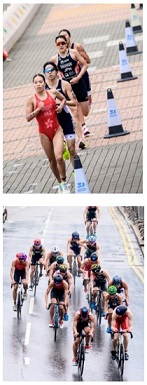
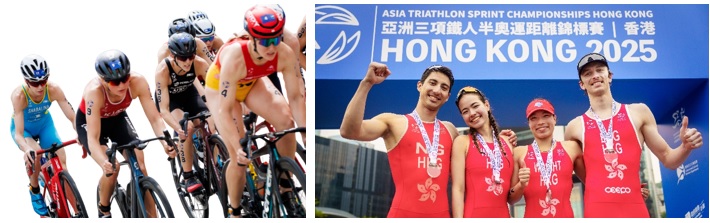
The Making of Triathletes
Established in 1984, the Triathlon Association of Hong Kong China (the Association) oversees triathlons, duathlons, aquathlons, and other similar events, and is committed to the development of the sport locally. To systematically nurture talent, the Association organises a range of programmes funded by the LCSD, including courses under the School Sports Programme, the Young Athletes Triathlon Training Scheme, and the Triathlon Grass Root Athlete Training Course. These initiatives aim to spark young people’s interest in triathlon while identifying and developing future stars. In parallel, the Association and its affiliated clubs also offer adult training courses, encouraging wider public participation.
In addition, the Association regularly hosts competitions ranging from local races such as the Hong Kong Triathlon Championships to international sporting events, including the 2024 World Triathlon Cup – Hong Kong and the 2025 Asia Triathlon Sprint Championships Hong Kong. These events not only raise the sport’s profile but also elevate the competitive standards of local athletes.
In recent years, a new generation of Hong Kong triathletes has come to the fore. Ng Tai-long Jason became the fourth Hong Kong triathlete to compete in the Olympics at the Paris 2024. Furthermore, at the 2025 Asia Triathlon Cup Gamagori held in Japan in September 2025, Hong Kong, China representatives Robin Elg, Oscar Coggins, Bailee Brown and Choi Yan-yin Hilda captured the gold medal in the mixed relay event. These achievements fully demonstrate the growing maturity of triathlon in Hong Kong and the continuous improvement in athlete performance. In recognition of their outstanding performance, triathlon has now been designated as a “Tier A” elite sport by the Hong Kong Sports Institute, qualifying it for focused support.
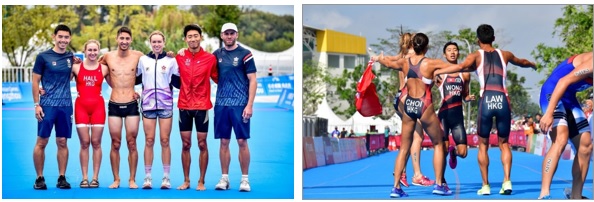
Iron Will, Hong Kong Spirit
When it comes to iconic figures in Hong Kong triathlons, none is more emblematic than “Hong Kong’s Chief Ironman”, Lee Chi-wo Daniel. He has represented Hong Kong, China in numerous major events, including the Olympic Games, Asian Games, and National Games. His career highlights include winning a silver medal in the men’s individual event at the 2006 Doha Asian Games and ranking third among Asian contestants at the Beijing 2008 Olympic Games. In an interview, Lee shared that in most of the competitions he entered, medals were out of reach. Yet he never once considered giving up. Through triathlon, he came to understand that there are no shortcuts to success, learning instead to confront setbacks and pursue excellence with perseverance.
This iron will, forged through adversity, is shared by every Hong Kong triathlete. For them, triathlon is far more than a test of physical endurance; it is a continuous journey of self-challenge. When athletes push forward at the brink of exhaustion, the perseverance and determination they display vividly embody the very essence of the Hong Kong spirit. Let us celebrate the unique charm of triathlon, “the relentless pursuit of breaking limits”, and continue to cheer on every Hong Kong triathlete striving on the course.