 Community Sports Club BulletinLeisure and Cultural Services Department

Portraits of National Sports Association
Page 5
Fencing Association of Hong Kong, China
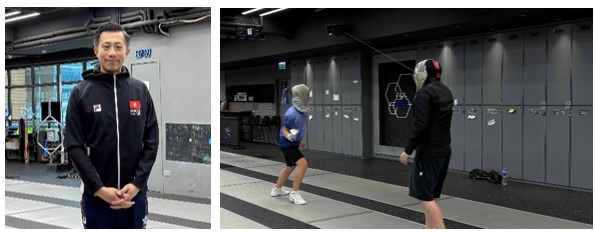
Fencing is enjoying unprecedented popularity in Hong Kong, fueled by the city’s first-ever gold medal in the men’s foil team event at the recent 15th National Games. Yet such success did not happen overnight. The roots of fencing in Hong Kong can be traced back to the Interwar Period, when students studying at renowned institutions like Oxford and Cambridge picked up the sport and brought it home. In 1949, the Hong Kong Amateur Fencing Association, now known as the Fencing Association of Hong Kong, China (the Association), was established and later joined the International Fencing Federation, marking Hong Kong onto the global fencing stage.
Foil, Epee and Sabre: Distinct Rules and Disciplines
Fencing comprises three disciplines: foil, epee and sabre, each governed by distinct rules and equipment. In foil, points are scored by touching the opponent’s metallic vest with the tip of the blade. In epee, the entire body is a valid target, and a touch with the tip on any part of the opponent’s body scores. Sabre differs in that scoring can be made with the entire edge of the blade, but a valid hit must land above the waist.
First-time spectators are often puzzled when a scoring light flashes but no point is awarded. This is due to the “right of way” rule in foil and sabre. Simply put, if both fencers land a valid hit simultaneously, the point is awarded to the fencer who initiates the attack. Fencing demands tactical flexibility and split-second decision-making, qualities that mirrors the adaptability and quick thinking Hong Kong people are known for, which may help explain why the sport has found such fertile ground locally.
Parallel Growth of Elite Training and Mass Participation
Fencing developed steadily in post-war Hong Kong, Inter-school competitions gained momentum in the 1960s, and the city entered the Asian fencing spotlight in 1978 when Hong Kong amateur fencers clinched a fourth place at the Bangkok Asian Games for the first time. A major shift came around the turn of the millennium with the founding of the first homegrown fencing club, moving the sport beyond school-based promotion. Today, Hong Kong has 30 to 40 fencing clubs, with participation continues to rise.
Since 2013, the Association has worked closely with the Hong Kong Sports Institute to professionalise coaching. In 2016, following the return of Head Coach Zheng Kang-zhao to the Hong Kong team, elite coaches were paired with athletes, creating a synergy effect that brought about huge improvement in overall performance. A clear and transparent athlete selection system has also been established to ensure fairness and impartiality.
Youth development and community engagement remain a priority. In recent years, collaborations with the School Sports Federation have introduced age-group divisions for epee and sabre in primary school competitions, while subsidy programmes provide access to fencing for children from low-income families .
Furthermore, the Association actively organises major competitions, including the upcoming Fencing World Championships in July 2026, as well as local competitions across all age-groups. A comprehensive competition framework, coupled with a dual-track strategy promoting both elite performance and mass participation, has laid a solid foundation for the continued growth of fencing in Hong Kong.
Coaches: The Unsung Heroes
Hong Kong’s string of victories in recent years has fuelled a fencing craze in town. Cheung Ka-long, won gold in men’s individual foil at the Tokyo 2021 Olympics and successfully defended his title at Paris 2024, where Vivian Kong Man-wai also claimed gold in women’s individual epee. Meanwhile, their fellow foil fencer Ryan Choi Chun-yin clinched gold at the 2025 World Championships, becoming the first Hong Kong athlete to earn a world title in fencing.
Lam Hin-chung, Secretary of the Association, paid tribute to the coaches as the true unsung heroes behind the team's success. He emphasised that behind the glory of athletes on the podium are years of quiet dedication of the coaches, who guide athletes through injuries and setbacks, and tailor strategies and training for each fencer. Therefore, the Association is committed to promoting professionalism, ensuring coaches and athletes advance together to scale new heights for Hong Kong.
Meeting Tomorrow's Challenges, Forging a Brighter Future
Following its historic success at the 15th NG, the Association has turned its focus to delivering a successful 2026 World Championships, with preparations now in full swing. To further the development of fencing, the 2024 Policy Address proposed the construction of a sports arena with fencing training and competition facilities. The industry hopes this project can be expedited to accommodate athletes’ increasingly intensive training and competition schedules and to lay a solid foundation for the sport’s long-term growth in Hong Kong.
From an imported pastime brought back by students to a sport that consistently achieves outstanding results on the international stage, fencing in Hong Kong has come a long way. With continued support from all sectors of society, fencing will undoubtedly continue to advance further, enabling more of our fencers to shine on the world stage.